
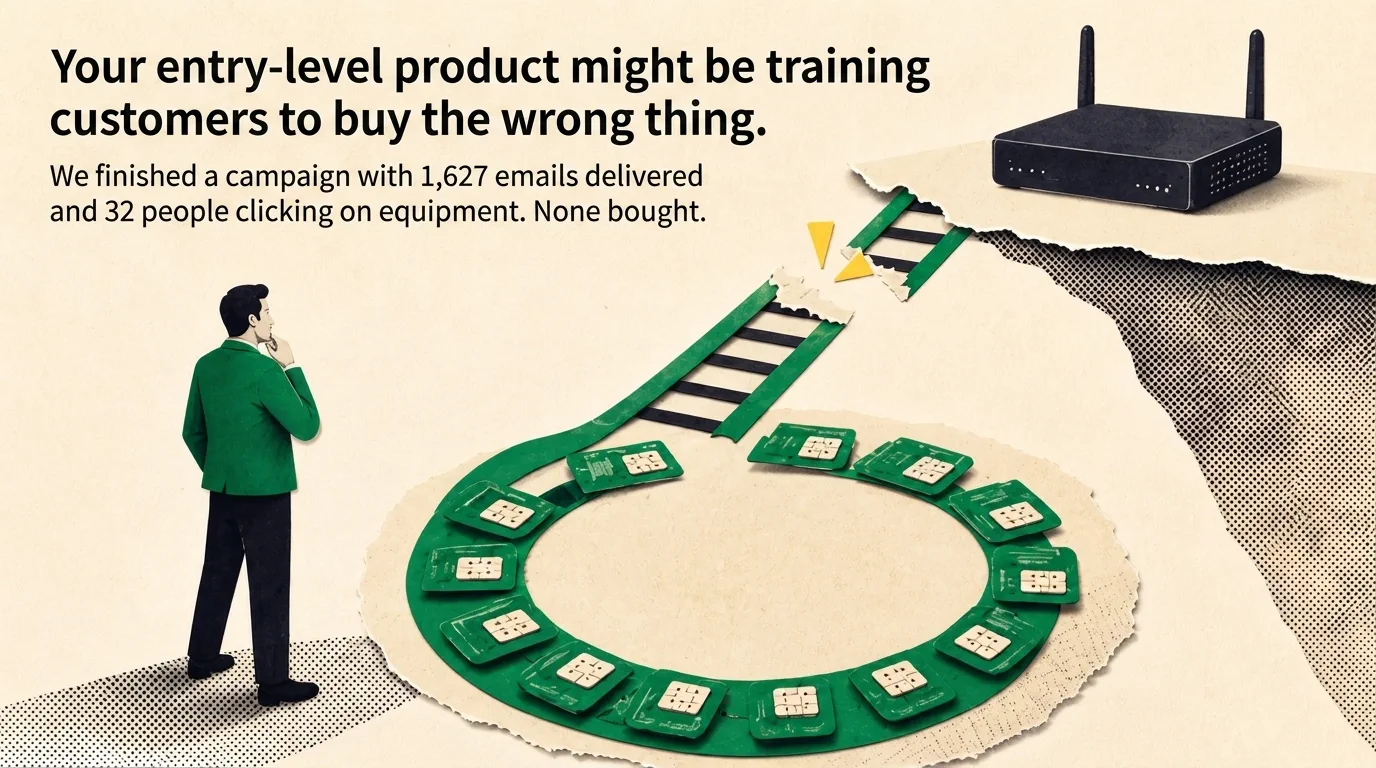
We finished a campaign with 1,627 emails delivered and 32 people clicking on equipment. None bought.
The hypothesis seemed coherent: those who had already purchased a rural connectivity chip could move up to a router or other equipment. We set up the campaign to test this progression.
By crossing the recipients with confirmed orders, we found a different behavior. Those who returned to buy chose a chip once again, without having previously clicked on the equipment in the campaign.
We had treated a cheap purchase as the first step of a ladder. For these customers, it served a replenishment function. The next purchase repeated the same solution.
This difference changes the cross-sell math. A low entry price helps little when the customer associates your company with a recurring need and classifies equipment into a different purchase category.
After the test, we discarded the ladder hypothesis and prepared the next campaign for equipment buyers, excluding customers who had purchased chips. The team began choosing the audience based on the product's role in each customer's history.
Today, I look for two pieces of evidence before financing a cross-sell: real sequences between categories and the time between purchases. We use clicks to diagnose the message and orders to verify if the commercial progression actually exists.
If you sell an entry-level item, design your next campaign based on what customers bought after it. A ladder imagined by the company may function as a replenishment cycle for the buyer.